
Long Visa Wait Times May Be Affecting Lucrative U.S. Tourism Industry
Millions of international tourists visit the United States each year, contributing billions of dollars to the national economy. But tourism declined from 2024 to 2025 and still has not returned to pre-pandemic levels.
Long wait times for tourism visa interviews may be contributing to the decline. Visitors from some countries may wait months to schedule these interviews.
Today’s WatchBlog post looks at our recent report on what’s causing these wait times and how they can be reduced.
Image

The range of wait times for visitor visas
Many international travelers who are temporarily visiting the U.S. must get a nonimmigrant visa from the Department of State (State) before they arrive in the country. Most nonimmigrant or “visitor” visas fall into two categories—business and tourist. Post-pandemic, demand for these visas has surged. Average global wait times for obtaining a visitor visa have significantly increased since before the pandemic, which could potentially impact tourism. This increase has been in part because State has struggled to process applications in a timely manner in some high demand countries.
Worldwide Nonimmigrant Visa Applicants, Fiscal Years 2019-2025
Image
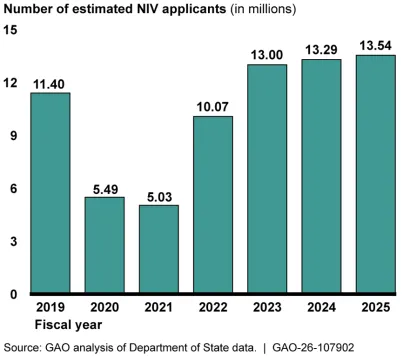
In adjudicating visas, State must balance speed and efficiency with national security concerns. While the visa application process involves several steps to ensure national security, such as reviewing documents and collecting fingerprints, the step driving long wait times is an in-person interview. This must be scheduled with a State official at a consulate in the applicants’ home country or a third country. In FY 2019, the average wait time for a visa interview across all countries was 26 days. By FY 2025, that rose to 201 days. In some countries, wait times were even longer. In Colombia, for example, the wait was 597 days.
What’s causing longer wait times?
One factor affecting State’s ability to conduct interviews more quickly is staffing. Last year, State reduced the number of full-time staff working on visitor visas by 32% (from 1,342 to 904). With fewer staff to conduct interviews, consular posts with high visa demand will likely continue to experience long wait times.
Adjudicators Working on Nonimmigrant Visa Applications Worldwide, FY19-25
Image
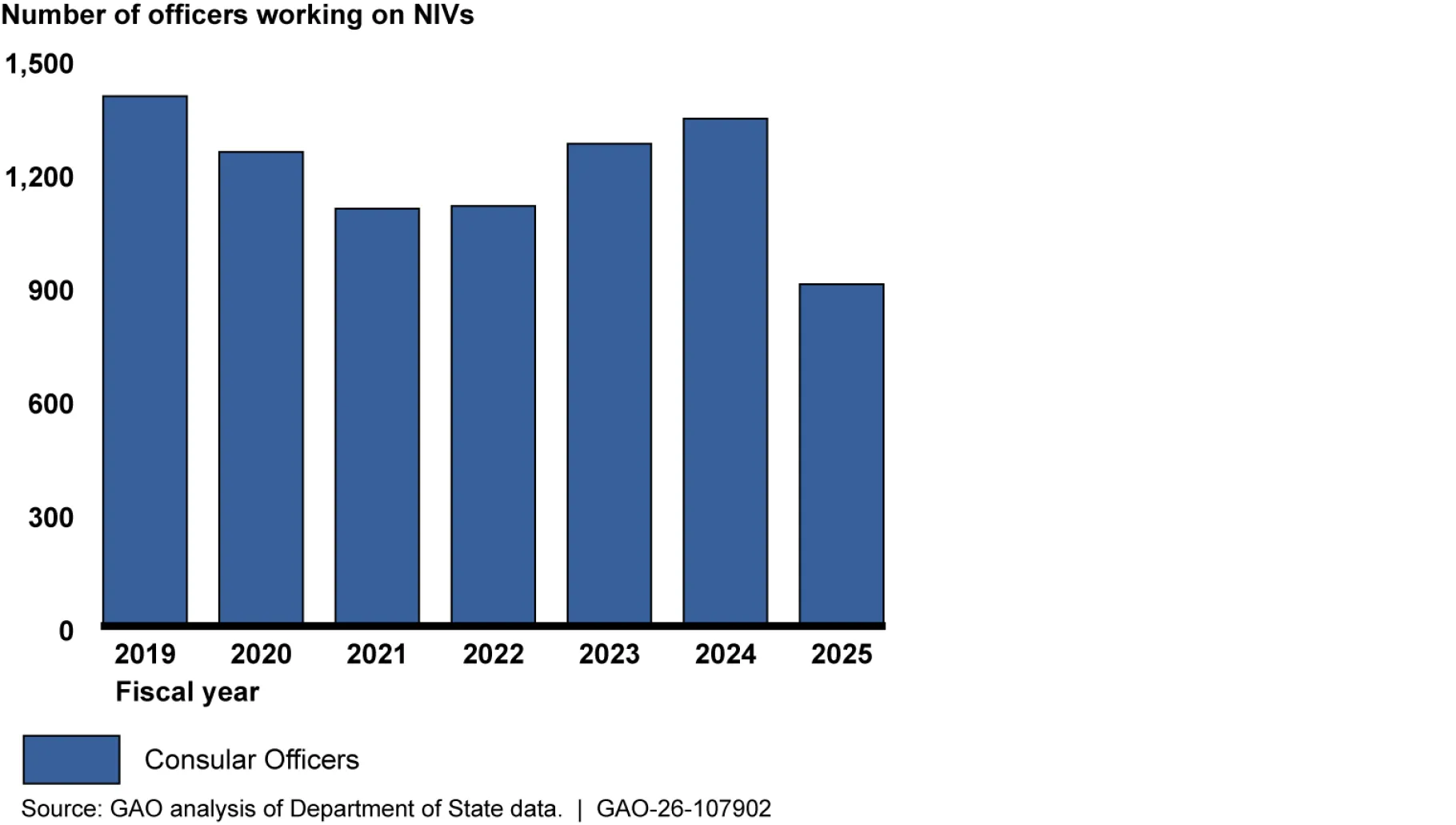
Another key factor affecting wait times is that State has not consistently conducted its annual Global Repositioning Exercise or GREX. The GREX is used to ensure staffing levels at consulates around the world match workloads and changing policy priorities. This is intended to be an annual survey. But State has not conducted and implemented one since FY 2023 because of staffing and other changes at the department. Without a GREX, there may be too few staff in countries with high demand for visa interviews. And this could be contributing to long wait times.
What can be done to reduce wait times?
State has taken some steps to address long wait times, such as:
Remote processing. Specialized staff located in Washington, D.C. help reduce workloads at high demand consulates by processing visa renewals that do not require an interview. Staff in locations with lighter workloads can also help process these applications remotely.
Global Support Strategy. Under this strategy, State has contracted out certain support work for visa operations. This includes things like appointment scheduling, fee collection, or document delivery. Outsourcing these administrative activities gives State officials more time for interviews and other key activities.
Management practices. State officials told us about new management practices that they believed helped improve wait times. These included conducting interviews in shifts to maximize facility space, working extra hours on Saturdays, and more.
Although these practices may help with wait times, there is still room for improvement. We recommended that State make it a requirement to consistently conduct its GREX moving forward to ensure proportionate levels of staff to workload at each post. This could help minimize visa wait times and positively affect the U.S. economy by increasing tourism.
To learn more about wait times for visitor visas, read our recent report.
- GAO’s fact-based, nonpartisan information helps Congress and federal agencies improve government. The WatchBlog lets us contextualize GAO’s work a little more for the public. Check out more of our posts at GAO.gov/blog.
- Got a comment, question? Email us at blog@gao.gov.
GAO Contacts
Image



Related Products

GAO's mission is to provide Congress with fact-based, nonpartisan information that can help improve federal government performance and ensure accountability for the benefit of the American people. GAO launched its WatchBlog in January, 2014, as part of its continuing effort to reach its audiences—Congress and the American people—where they are currently looking for information.
The blog format allows GAO to provide a little more context about its work than it can offer on its other social media platforms. Posts will tie GAO work to current events and the news; show how GAO’s work is affecting agencies or legislation; highlight reports, testimonies, and issue areas where GAO does work; and provide information about GAO itself, among other things.
Please send any feedback on GAO's WatchBlog to blog@gao.gov.