
Drone Deliveries Expected to Increase Substantially As Concerns About Safety Remain
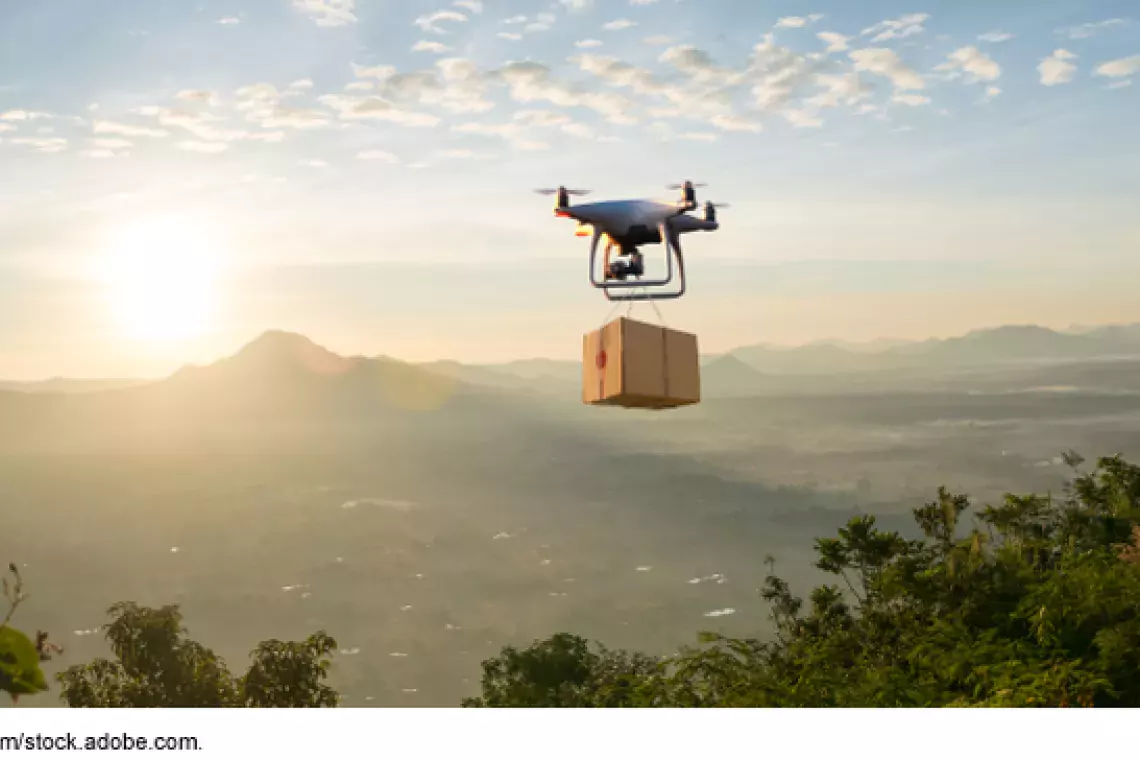
Drones are increasingly being used to deliver packages and food orders. These commercial drones often fly beyond the line-of-sight of their operator—meaning the person piloting the drone can’t see it but instead relies on other means to detect and avoid collisions.
As you can imagine, these types of operations have raised some safety concerns, which are expected to increase as drone delivery use takes off.
Today’s WatchBlog post looks at our new report on the technologies that may improve drone safety and how the Federal Aviation Administration (FAA) is regulating this new form of air traffic.
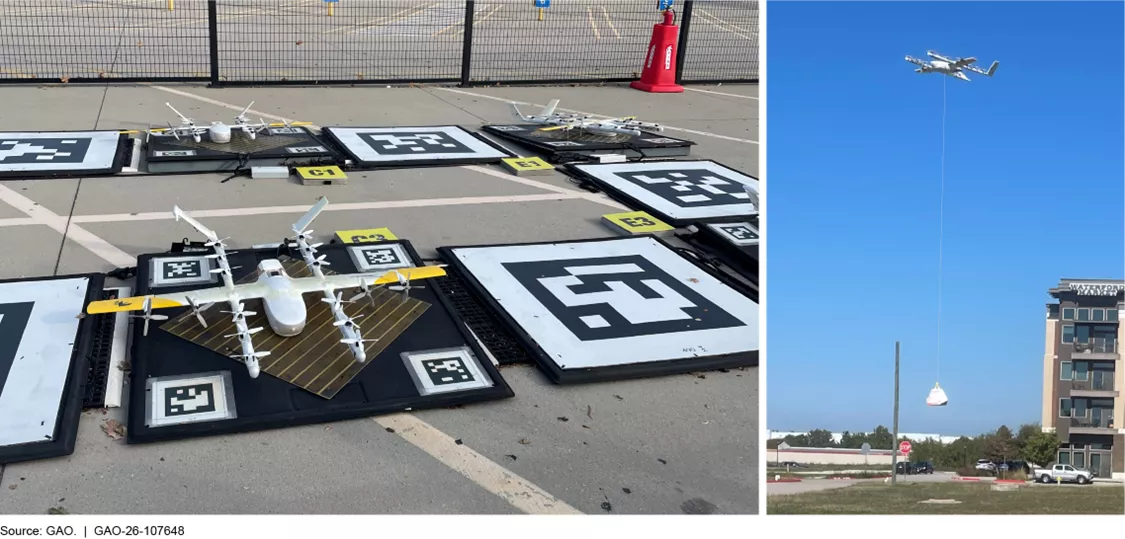
Drones Used for Preparing and Executing Delivery Services in North Texas
Image
Out of sight, top of mind: detecting and avoiding other aircraft
By the end of last year, more than 1 million commercial drones were already being used for everything from delivering takeout to surveying disaster sites from above.
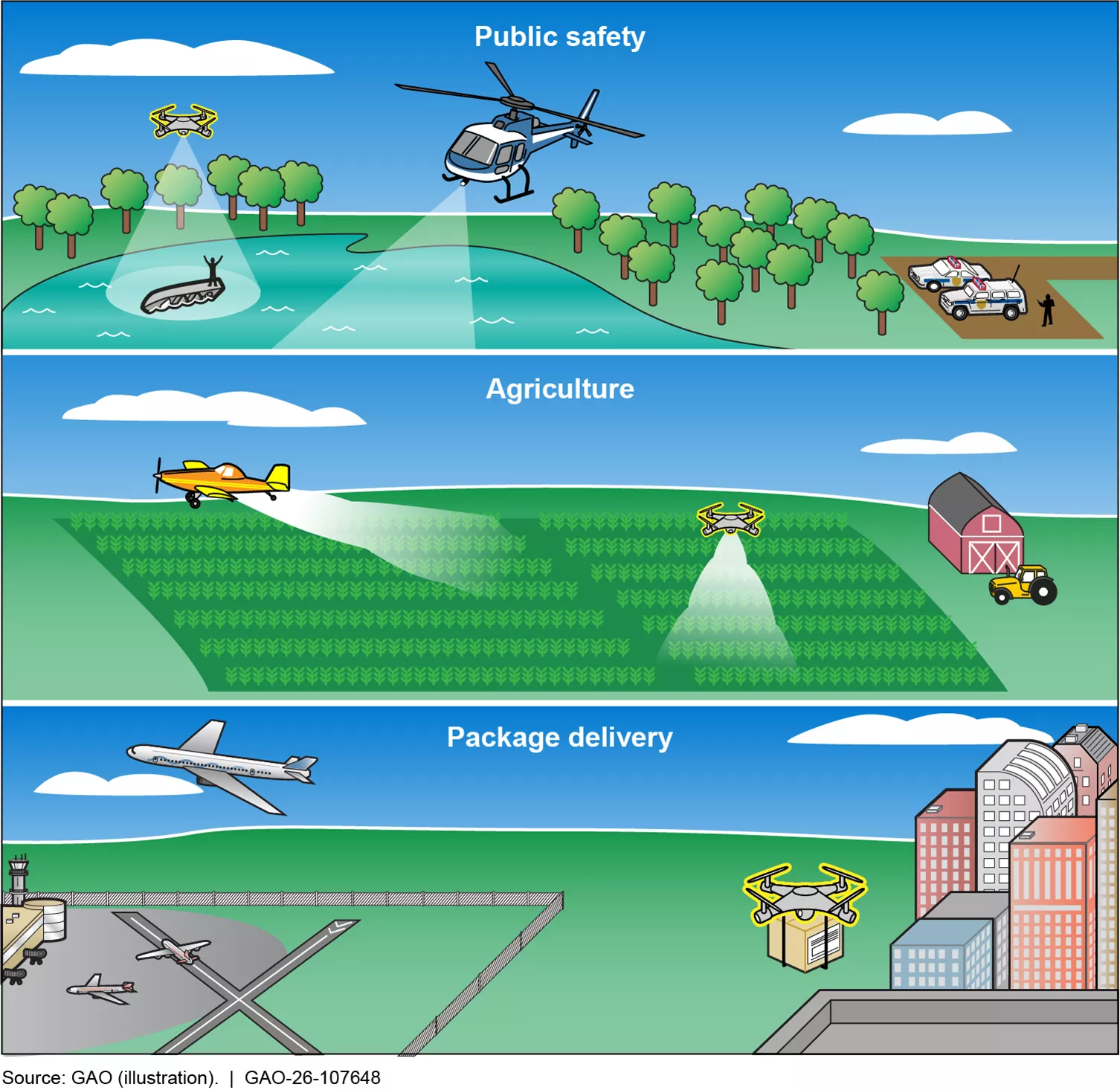
As commercial drone use increases, FAA is working with private industry to study drone traffic management and improve safety. For example, in North Texas, retailers are working with drone delivery companies and using some detect-and-avoid technologies to enable package deliveries. As they do, they are also collecting data to inform future commercial operations. These technologies may help reduce risks of midair collisions when operating drones beyond line-of-sight.
Drone Applications That May Encounter Manned Aircraft at Low Altitude
Image
There are some existing technologies that drones use to avoid mid-air collisions. These include:
- Cameras mounted on the drone, ground, or both can provide operators with a 360-degree view around the drone.
- Acoustic sensors that use sensitive microphones and audio analysis to detect and identify the sound of other aircraft. This tech can even determine the general direction of the sound source.
- Ground-based radar information that allows operators to detect other aircraft and maneuver away.
- ADS-B—or automatic dependent surveillance-broadcast—an advanced technology that conveys an aircraft’s location, altitude, and speed. Aircraft may be equipped to broadcast their own data (ABS-B Out), receive data from others (ADS-B In), or both.
ADS-B is the main technology used by manned aircraft to communicate with each other, but it is not as simple as drones using the same technology to communicate. Drones are allowed to receive ADS-B information from other aircraft but they are generally prohibited from broadcasting their own information. This is because if too many drones transmitted ADS-B Out signals, it could overwhelm the system potentially endangering manned aircraft like passenger planes, helicopters, and more.
Integrating drones into the National Airspace System
Because of the risks associated with flying drones in the same airspace as manned aircraft, FAA will need to make changes before commercial drone use is more widely adopted. The lack of two-way communication between drones and other aircraft presents a big challenge. In the future, FAA hopes to transition to a new, information-centric National Airspace System in which all users share location information. To achieve this, new technology is needed.
The FAA has already proposed new rules requiring drones that fly beyond line-of-sight to detect and avoid other aircraft. However, FAA has not developed specific plans to address how drones will communicate with other aircraft. In our recent report, we recommended FAA do so.
To learn more about drone detect-and-avoid technology and the future of drones in the National Airspace System, read our full report.
- GAO’s fact-based, nonpartisan information helps Congress and federal agencies improve government. The WatchBlog lets us contextualize GAO’s work a little more for the public. Check out more of our posts at GAO.gov/blog.
- Got a question or comment? Email us at blog@gao.gov.
GAO Contacts
Image

Related Products
GAO's mission is to provide Congress with fact-based, nonpartisan information that can help improve federal government performance and ensure accountability for the benefit of the American people. GAO launched its WatchBlog in January, 2014, as part of its continuing effort to reach its audiences—Congress and the American people—where they are currently looking for information.
The blog format allows GAO to provide a little more context about its work than it can offer on its other social media platforms. Posts will tie GAO work to current events and the news; show how GAO’s work is affecting agencies or legislation; highlight reports, testimonies, and issue areas where GAO does work; and provide information about GAO itself, among other things.
Please send any feedback on GAO's WatchBlog to blog@gao.gov.