
Colleges and Universities Rely Heavily on Contingent Faculty
It’s American Education Week and we’re reflecting on the changing employment landscape in colleges and universities.
Not so long ago, for many, a faculty career in higher education came with expectations of steady income and almost unparalleled job security. While continuous employment, or tenure, remains a valued feature of higher education institutions, we’re seeing that more and more faculty are employed outside of the tenure track as “contingent faculty,” either part- or full-time. Depending on the school, these faculty members may be referred to as instructors, lecturers, or adjunct or visiting professors, among other terms.
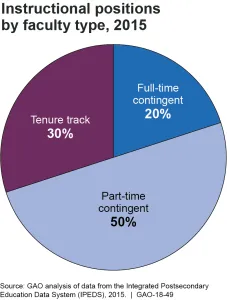
In 2017, we reported that contingent faculty filled about 70 percent of instructional positions nationwide during 2015. Today’s WatchBlog takes a closer look at the characteristics and work experiences of contingent faculty.
Image
Advantages and challenges of contingent faculty employment
Through interviews at public and private colleges and universities in three states, we learned about some of the advantages and challenges that contingent faculty—those in temporary, contract, or other nonstandard employment arrangements—may face.
Contingent faculty described some advantages of their work arrangements such as flexibility to balance professional and personal responsibilities and the opportunity to work with students.
However, they also noted many disadvantages, including job uncertainty, untimely contract renewals, low pay, and limited career advancement opportunities. Such concerns were also reflected more broadly in data we analyzed on faculty compensation and job satisfaction.
How do administrators choose what type of faculty to employ?
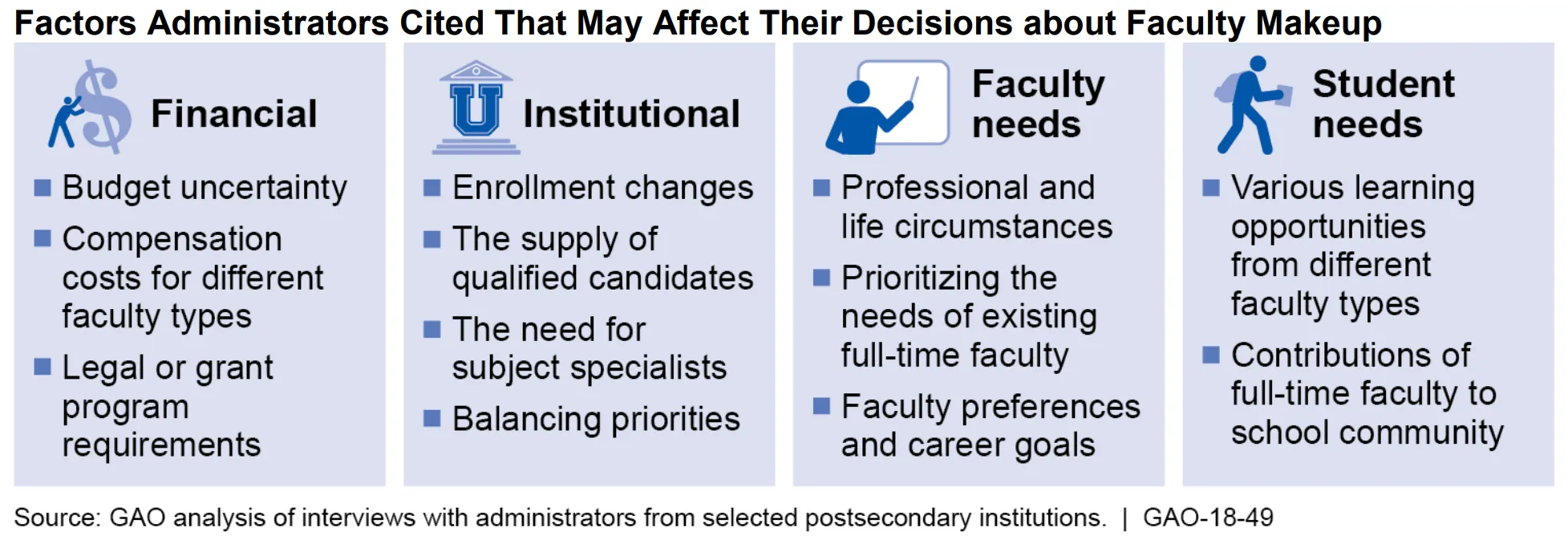
School administrators cited a number of factors that affect their decisions about the type of faculty to employ. They include financial, institutional, and faculty and student needs, such as:
- budgetary constraints,
- enrollment changes and requirements for subject specialists,
- current faculty preferences and career goals, and
- students’ curriculum choices.
Image
We also learned that circumstances affecting the choice of contingent employment may vary from one individual to another. For example, a younger academic seeking a career in higher education may have very different goals and preferences from a retired professional desiring to teach part-time. Reasons for hiring certain types of faculty may also vary across different types of colleges and universities, based on factors such as geographic location or the need for faculty in certain specializations.
As a result, potential federal solutions to the challenges experienced by contingent faculty may have to take into account many different needs and viewpoints.
To learn more, check out our full report.
- Comments on GAO’s WatchBlog? Contact blog@gao.gov.
GAO Contacts
Image



Related Products

GAO's mission is to provide Congress with fact-based, nonpartisan information that can help improve federal government performance and ensure accountability for the benefit of the American people. GAO launched its WatchBlog in January, 2014, as part of its continuing effort to reach its audiences—Congress and the American people—where they are currently looking for information.
The blog format allows GAO to provide a little more context about its work than it can offer on its other social media platforms. Posts will tie GAO work to current events and the news; show how GAO’s work is affecting agencies or legislation; highlight reports, testimonies, and issue areas where GAO does work; and provide information about GAO itself, among other things.
Please send any feedback on GAO's WatchBlog to blog@gao.gov.