
Supplemental Nutrition Assistance Program: Federal Actions Needed to Help Veterans Access Benefits
Fast Facts
More than a million veterans have limited or uncertain access to food. Eligible veterans can get Supplemental Nutrition Assistance Program benefits to help, but they're less likely to participate than non-veterans. Federal, state, and relevant organizations' officials told us that veterans may have misconceptions about SNAP.
This Q&A reviews SNAP's veteran outreach. While the Department of Agriculture has taken steps to make veterans more aware of SNAP, it could do more. For example, it doesn't have veteran-friendly outreach materials with up-to-date information.
We recommended addressing this and more to help veterans access benefits.
Supplemental Nutrition Assistance Program and EBT Food Stamp Benefits sign
Highlights
What GAO Found
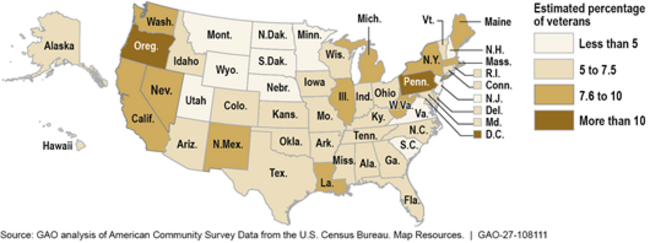
According to a 2023 RAND report, an average of 1.4 million veterans faced food insecurity each year from 2015 to 2020, meaning their households did not have enough food for an active and healthy life. The Supplemental Nutrition Assistance Program (SNAP) provides benefits to low-income households to buy food. The U.S. Department of Agriculture (USDA) administers SNAP in partnership with states. The share of veterans receiving benefits varies by state, according to GAO’s analysis of Census Bureau data.
Estimated Percentage of Veterans Who Lived in Households Receiving Supplemental Nutrition Assistance Program Benefits by State in 2024
States have the option to conduct outreach to increase awareness of SNAP and may target outreach to certain groups, such as veterans. States must have a USDA-approved outreach plan to receive partial federal reimbursement for their outreach expenses. Most states with outreach plans in fiscal year 2026 (39 of 47) identified veterans as a target group.
However, stakeholders GAO interviewed reported that veterans' misconceptions about SNAP hinder outreach efforts. USDA has not developed outreach materials tailored to veterans in the past 5 years, despite recent program changes for veterans. Several stakeholders said that outreach materials, such as talking points dispelling myths about SNAP, would help them communicate more effectively with veterans. By developing and disseminating such materials, USDA could help ensure that trusted messengers, like veterans’ organizations, share accurate and up-to-date information on the program with food-insecure veterans.
The Department of Veterans Affairs (VA) and USDA established a memorandum of agreement (MOA) to address veteran food insecurity in September 2023. However, the agencies’ collaborative efforts have slowed since April 2025 following the loss of key staff at USDA, according to VA officials. Agency officials told GAO they consider the MOA to still be in place; however, the agencies have not reviewed the MOA as specified in the agreement, making the current status of the MOA unclear. By ensuring a formal mechanism is in place to guide their collaboration, VA and USDA can enhance their efforts to ensure low-income veterans and their families have access to the food they need through programs like SNAP.
Why GAO Did This Study
Research has shown that food-insecure veterans are less likely than their nonveteran peers to participate in SNAP.
GAO was asked to review states’ efforts to target SNAP outreach to veterans and work with veterans’ organizations to help connect veterans to the program. This report examines state and federal efforts to conduct SNAP outreach to veterans.
GAO reviewed relevant federal laws, regulations, and agency documentation. GAO also analyzed survey data on veteran households’ receipt of SNAP benefits and reviewed states’ most recent SNAP outreach plans and reports. In addition, GAO interviewed VA and USDA officials and representatives of 16 stakeholder organizations, including national organizations with expertise on food assistance or veterans issues, as well as state SNAP agencies, outreach partners, and VA medical centers from three states. GAO selected states that were actively conducting SNAP outreach to veterans and varied by geographic region and the share of veterans receiving SNAP benefits. GAO selected other stakeholder organizations for their national perspectives on veteran food security issues.
Recommendations
GAO is making four recommendations, including that USDA develops and disseminates additional SNAP outreach materials tailored to veterans and that VA and USDA ensure a formal mechanism is in place to collaborate on efforts to address veteran food insecurity. We provided a draft of this report to VA and USDA for review and comment. VA and USDA concurred with GAO’s recommendations.
Recommendations for Executive Action
| Agency Affected | Recommendation | Status |
|---|---|---|
| Department of Agriculture | The Secretary of Agriculture should ensure FNA's SNAP eligibility website includes up-to-date information about exceptions to the SNAP time limit. (Recommendation 1) |
When we confirm what actions the agency has taken in response to this recommendation, we will provide updated information.
|
| Department of Agriculture | The Secretary of Agriculture should ensure FNA develops and disseminates additional SNAP outreach materials tailored to veterans, in collaboration with VHA. (Recommendation 2) |
When we confirm what actions the agency has taken in response to this recommendation, we will provide updated information.
|
| Department of Agriculture | The Secretary of Agriculture should ensure a formal mechanism is in place to collaborate with VA on efforts to address veteran food insecurity. This could include reviewing the MOA and updating the agreement as needed. (Recommendation 3) |
When we confirm what actions the agency has taken in response to this recommendation, we will provide updated information.
|
| Department of Veterans Affairs | The Secretary of Veterans Affairs should ensure a formal mechanism is in place to collaborate with USDA on efforts to address veteran food insecurity. This could include reviewing the MOA and updating the agreement as needed. (Recommendation 4) |
When we confirm what actions the agency has taken in response to this recommendation, we will provide updated information.
|