
Nuclear Waste Cleanup: DOE Is Missing Opportunities to Apply Lessons from Other Countries That Could Reduce Risks and Costs
Fast Facts
Nuclear waste cleanup can be costly, risky, and time consuming. The Department of Energy's cleanup efforts in the U.S. will cost over $640 billion and take decades.
We looked at how several other countries have saved money, reduced risks, and accelerated cleanup efforts.
The UK focused its cleanup efforts based on the environmental and health risks the waste poses, saving over $2.6 billion. Canada prioritized cleanup activities at key waste sites, which will expedite completion at one site by 30 years.
But DOE hasn't fully collaborated with other countries to learn how their approaches could improve its own efforts. We recommended doing so.
This page was updated to correct the photo source line.
Nuclear Waste Cleanup Project in a Former Salt Mine in Germany
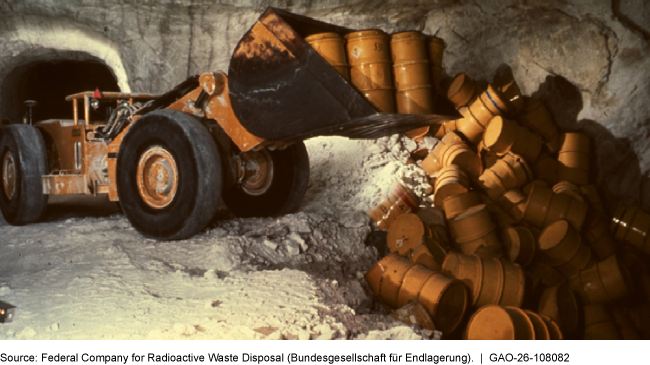
Inside an underground chamber with rock walls, a large industrial vehicle moves several yellow cylindrical drums that resemble barrels to a pit that is partially filled with other drums.
Highlights
What GAO Found
Many countries are undertaking efforts to manage, treat, and dispose of nuclear waste. Several have taken actions that accelerated cleanup, reduced risks, and resulted in cost savings—lessons that could inform the U.S. Department of Energy’s Office of Environmental Management (EM) efforts. For example:
- The United Kingdom (UK) saved a total of at least £2 billion (equivalent to $2.6 billion as of March 2026) by implementing a risk-informed approach to managing its nuclear waste. This approach helped minimize how much waste would need disposal in a repository for waste low in radioactivity.
- Canada has prioritized accelerating cleanup activities at key nuclear waste sites. As a result, it expects to complete cleanup activities at one of these key sites nearly 30 years ahead of schedule.
- France and the UK have used test facilities that replicate operating facilities to address technical issues and train employees. These efforts have saved each country significant money and minimized disruptions to cleanup efforts.
Decommissioned Nuclear Boilers Diverted for Recycling Instead of Disposal in the United Kingdom’s National Low Level Waste Repository

EM engages with other countries about nuclear cleanup, but this engagement is limited and not done strategically to identify alternative approaches that could reduce costs and risks at EM’s 15 cleanup sites in the United States. For example, EM participates in international working groups but does not disseminate lessons learned from other countries to EM’s decision-makers. GAO and other organizations have long reported on challenges facing the EM cleanup mission, including that EM does not have a fully risk-informed approach to cleanup. EM site officials told GAO they want more opportunities to engage with other countries, but EM headquarters officials stated that they typically teach other countries, rather than learn from them. Until EM more strategically engages with other countries to identify and evaluate alternative nuclear cleanup approaches, EM will continue to miss opportunities to employ new approaches that its decision-makers could use to reduce risks and costs across the EM complex.
Why GAO Did This Study
Many countries have nuclear waste resulting from activities such as weapons production, nuclear power generation, and medical uses. Efforts to address this waste can be costly, take decades, and present common challenges. EM is responsible for cleaning up 15 sites across the United States contaminated by nuclear weapons production and energy research. EM has estimated that its cleanup mission could cost between $641 billion and $840 billion and take until 2100.
Senate Report 118-188 includes a provision for GAO to report on EM’s efforts to leverage other countries’ lessons learned for managing nuclear waste. This report examines (1) selected countries’ nuclear waste management approaches from which EM could learn, and (2) the extent to which EM has considered other countries' approaches for nuclear waste cleanup.
GAO reviewed documents for six selected countries: Belgium, Canada, France, Germany, Japan, and the UK. GAO interviewed officials from five of these countries and visited selected sites in France and the UK. GAO analyzed documents and interviewed officials from EM headquarters and received written responses from all 15 EM sites about their international engagements.
Recommendations
GAO recommends that EM strategically engage with other countries to identify and evaluate alternatives that could help reduce risks and costs or accelerate its cleanup activities. EM should disseminate identified approaches to EM decision-makers to explore and integrate into cleanup efforts, as appropriate. EM concurred with the recommendation.
Recommendations for Executive Action
| Agency Affected | Recommendation | Status |
|---|---|---|
| Department of Energy | The Assistant Secretary for Environmental Management should strategically engage with existing or new partner countries to identify and evaluate alternatives they have pursued that could help reduce risks and costs or accelerate nuclear cleanup efforts across the EM complex and periodically disseminate these approaches to EM site managers and EM decision-makers to explore and integrate into cleanup efforts, as appropriate. (Recommendation 1) |
When we confirm what actions the agency has taken in response to this recommendation, we will provide updated information.
|