
Nuclear Waste Cleanup: Clarifying Definition of High-Level Radioactive Waste Could Help DOE Save Tens of Billions of Dollars
Fast Facts
The Department of Energy is responsible for cleaning up millions of gallons of radioactive waste from nuclear weapons production. To do this, DOE must rely on a statutory definition of "high-level radioactive waste" that is unclear and hinders its mission. For example, the definition doesn't define the phrase "highly radioactive."
There have been concerns about this definition for decades. And, DOE hasn't fully evaluated or pursued opportunities to save tens of billions of dollars in how it treats and disposes of this waste. Our recommendations address these issues.
Underground Storage Tank with Radioactive Waste
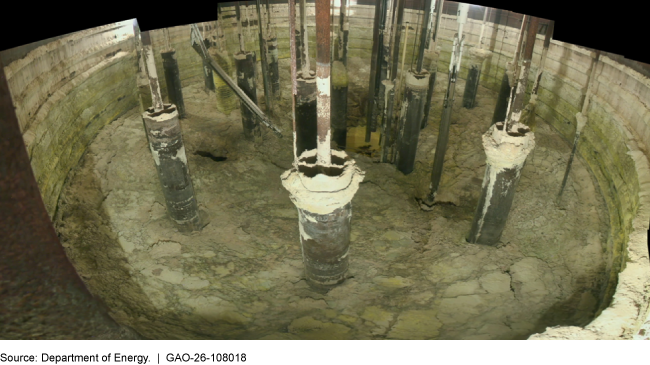
Inside an underground radioactive waste storage tank.
Highlights
What GAO Found
The Department of Energy’s (DOE) Office of Environmental Management (EM) is responsible for cleaning up waste resulting from the reprocessing of spent nuclear fuel, a process used to produce plutonium. Generally, EM manages this waste associated with reprocessing as if it is high-level radioactive waste (HLW) unless the waste can be classified as low-level radioactive waste (LLW) or transuranic (TRU) waste. LLW and TRU waste are expected to be less expensive to treat and dispose of compared with HLW. To classify its waste, EM relies in part on the statutory definition of HLW in the Atomic Energy Act of 1954, as amended, and the Nuclear Waste Policy Act of 1982, as amended. However, GAO, DOE, and others have raised concerns that ambiguities in this definition have impeded EM’s cleanup progress.
Examples of Waste Associated with Reprocessing
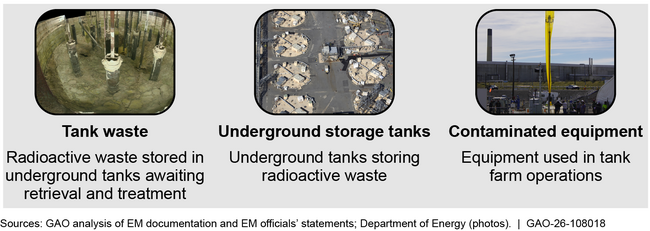
EM has three processes—known as waste classification tools—it can use to determine that certain waste associated with reprocessing can be treated and disposed of as LLW or TRU waste, rather than HLW. While these tools help EM address ambiguities in the HLW definition, they have shortcomings that hinder EM’s progress. For example, one tool cannot be used at the Hanford Site, EM’s most complex and expensive site. EM also faces the risk of litigation due to the lack of clarity in the HLW definition, which could affect EM’s ability to successfully use the tools. Until the HLW definition is clarified, EM will continue to face significant barriers to completing its cleanup mission. Given the complexity of this issue, any efforts to revise the HLW definition would benefit from input and ideas from experts across government, industry, and academia.
While EM has applied the three tools to treat and dispose of some waste associated with reprocessing as non-HLW, EM has not pursued additional opportunities that GAO and others have identified. Many studies over the last 2 decades—including analyses conducted by EM—have shown that opportunities exist for EM to expedite its cleanup efforts and realize significant cost savings while ensuring safe disposal. For example, in a 2020 report, EM estimated that classifying a portion of tank waste as LLW at its Hanford Site could potentially generate a cost savings of $73 to $210 billion. By systematically evaluating these opportunities and pursuing them to the maximum extent possible, EM could accelerate its cleanup mission and save at least tens of billions of dollars.
Why GAO Did This Study
Since 1989, EM has been responsible for cleaning up waste resulting from plutonium production for the nation’s nuclear arsenal. EM has faced many challenges in determining how best to treat and dispose of this waste, and the estimated future cost for addressing this and other waste is more than half a trillion dollars.
Senate Report 118-188 includes a provision for GAO to review DOE’s implementation of certain tools to treat and dispose of waste associated with reprocessing as something other than HLW. GAO’s report examines (1) EM’s efforts to treat and dispose of such waste and the barriers it faces in doing so and (2) potential opportunities to realize cost savings by treating certain waste as something other than HLW.
GAO analyzed laws, EM policies and documentation, and prior GAO and independent entities’ studies. GAO interviewed EM officials regarding EM’s plans to treat and dispose of waste associated with reprocessing. GAO also visited two EM sites and evaluated documentation to identify opportunities for EM to treat and dispose of certain waste as LLW or TRU waste.
Recommendations
GAO recommends that Congress consider convening a panel of experts to recommend specific revisions to the statutory definition of HLW to address ambiguities in the definition.
GAO also recommends that EM systematically evaluate opportunities to treat and dispose of certain waste associated with reprocessing as something other than HLW and communicate to Congress regarding its efforts to implement these opportunities as well as actions Congress can take to minimize or eliminate any barriers impeding EM’s ability to pursue them. DOE agreed with the recommendation.
Matter for Congressional Consideration
| Matter | Status | Comments |
|---|---|---|
| Congress should consider convening a multidisciplinary panel, such as a Blue Ribbon Commission, comprising a group of relevant experts—for example, from key agencies, industry, and academia—to develop and recommend specific revisions to address ambiguities in the definition of HLW in the AEA and NWPA and to report these recommendations to Congress within 12 months. (Matter for Consideration 1) | We will continue to monitor Congress' actions to address this recommendation. |
Recommendations for Executive Action
| Agency Affected | Recommendation | Status |
|---|---|---|
| Office of Environmental Management | The Assistant Secretary for Environmental Management should systematically evaluate the full range of opportunities to treat and dispose of legacy waste associated with reprocessing as something other than HLW and communicate to Congress on (1) EM's plans to implement identified opportunities—or its rationale for not doing so—and (2) actions Congress can take to minimize or eliminate barriers that impede EM's ability to proceed with these plans. (Recommendation 1) |
In August 2026, EM told us that it believes it has implemented this recommendation and stated that it is systematically pursuing innovative strategies to treat and dispose of waste associated with reprocessing in a faster, safer, and more cost-effective way while remaining focused on EM's primary priority of protecting human health and the environment. Further, EM stated that the agency is committed to communicating its plans and progress to Congress and is ready to partner with Congress to ensure a collaborative path forward. To meet the intent of our recommendation, EM will need to provide evidence that it has systematically evaluated opportunities to treat certain waste as something other than HLW. Further, EM will need to provide evidence that it has communicated to Congress the results of this evaluation, including its efforts to implement identified opportunities as well as actions Congress can take to minimize or eliminate barriers impeding EM's ability to pursue them. By taking these steps, EM could accelerate a cleanup mission that has been underway for over 3 decades, realize tens of billions of dollars in potential cost savings, and provide congressional decision-makers with the information they need to support EM in its efforts.
|