
Military Personnel: DOD Should Improve Processes for Determining Cost-of-Living Allowances
Fast Facts
The Department of Defense assigns military personnel to over 3,500 different locations worldwide. The costs associated with living in these locations vary widely.
DOD pays cost-of-living allowances (COLA) to help military personnel with food, transportation, and other costs in some expensive locations. To calculate COLAs, DOD uses:
Data on military household spending
Location-specific surveys of shopping patterns
Price data for goods and services that military personnel buy
We found ways for DOD to improve how it collects this data, communicates about COLAs to service members, and more.
Our recommendations address these issues.

Military dog tags on a chain laying on top of U.S. currency.
Highlights
What GAO Found
The Department of Defense (DOD) uses three key processes to determine service member cost-of-living allowances (COLA), with separate programs for service members living in the continental U.S. (CONUS) and outside the continental U.S. (OCONUS). These processes include data on military household spending from the Department of Labor’s Bureau of Labor Statistics, location-specific surveys of shopping patterns, and retail price data for the goods and services that service members typically buy. DOD uses these processes to develop comparative prices for locations where it stations service members. DOD uses average CONUS prices as a baseline for determining eligibility for COLA. Using these processes, DOD determines a COLA rate for each eligible location. Payments to service members in these locations vary based on their spendable income and number of dependents. The department also tracks foreign currency fluctuations relative to the dollar to help determine COLA payments in OCONUS locations.
DOD’s Process for Determining COLA Rates, Calendar Year 2024
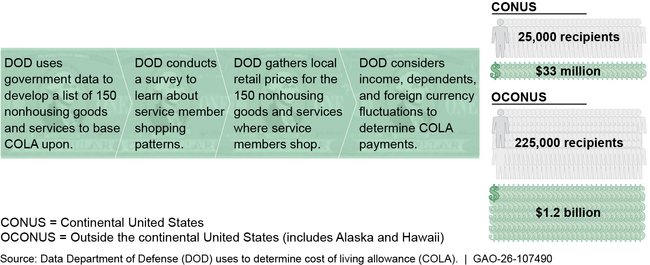
DOD’s processes for determining COLA rates CONUS and OCONUS have several weaknesses. Additionally, information about COLA rates can be better communicated to service members. Specifically:
- DOD’s survey for determining service members’ shopping patterns does not use sound sampling practices.
- DOD does not consistently use existing processes to capture location-specific expenses.
- DOD has inconsistent processes for determining dependent-based COLA compensation in CONUS and OCONUS.
- DOD posts information about COLA on a publicly available website, but there are inconsistencies in the amount and type of information local commands provide to service members at locations that receive COLA. Further, some service members told GAO that they did not understand their COLA payments.
Taking action to address these issues will help ensure service members are appropriately compensated, which will support their quality of life and their ability to meet mission needs.
Why GAO Did This Study
DOD assigns its 1.4 million active-duty service members to over 3,500 locations worldwide. DOD provides a COLA to assist service members with nonhousing expenses, such as food, in high cost areas.
The conference report accompanying the National Defense Authorization Act for Fiscal Year 2024 includes a provision for GAO to examine DOD’s COLA programs. This report (1) describes the processes DOD uses to determine COLA and payments for service members; and (2) examines the extent to which DOD’s COLA processes are appropriately designed and communicated.
GAO analyzed laws, regulations, policies, and COLA rates. GAO interviewed officials responsible for the COLA program and held discussion groups with service members in five locations in Hawaii, Japan, Alaska, Germany, and Virginia. Most of the site visits GAO held were at OCONUS locations because 97 percent of the COLA payments are OCONUS.
Recommendations
GAO recommends that DOD (1) use random sampling to survey service members on shopping patterns, (2) consistently apply its process for location-specific expenses, (3) consider aligning its CONUS and OCONUS dependent-based compensation, and (4) require local commands to provide information about COLA to service members. DOD concurred with the second and third recommendations, and partially concurred with the fourth recommendation. DOD non-concurred with the first recommendation, stating that its current method enhances survey participation. GAO’s recommendation remains valid as DOD’s current process does not produce statistically representative results.
Recommendations for Executive Action
| Agency Affected | Recommendation | Status |
|---|---|---|
| Department of Defense | The Secretary of Defense should direct the Under Secretary of Defense for Personnel and Readiness to ensure that the department uses random sampling for the LPS. (Recommendation 1) |
DOD did not concur with this recommendation. In an action plan from August 2026, the department stated that member participation in the data collection and rate setting processes for COLA improves service member satisfaction with the program and random sampling limits such participation. In the department's original response to our recommendations from April 2026, it further explained that it wants as many service members as possible to participate in the data collection instead of having small, random samples for the Living Pattern Survey (LPS). The department further stated that the responses it collects through the LPS are weighted to correct for non-response bias and ensure they accurately represent the entire population of the surveyed location. According to DOD, the quota sampling approach they use allows the department to construct a comprehensive and representative picture of the spending habits of all service members, effectively compensating for any missing data. However, we found that DOD cannot be sure that the completed surveys are a valid representation of service members' costs of living. The quota sampling methodology the department currently relies on is known to produce biased estimates and the weighting procedures it uses are not able to fully mitigate its shortcomings. We maintain that using random sampling for the LPS would improve the department's COLA determination process, as we recommended in April of 2026.
|
| Department of Defense | The Secretary of Defense should direct the Under Secretary of Defense for Personnel and Readiness to implement changes in the COLA process for OCONUS, such as using the LPS to consistently identify location-specific expenses and determine whether such expenses should be reimbursed, in accordance with DOD policy. (Recommendation 2) |
DOD concurred with this recommendation. In its response the department stated that it will actively encourage respondents to provide open-ended feedback in the comments section that is already a part of the Living Pattern Survey (LPS). The department plans to analyze the responses using artificial intelligence to process and summarize the themes and specific expenses reported for each location. In an action plan from August 2026, the department stated that it plans to develop the artificial intelligence protocols and systematically analyze the written comments to the LPS by April of 2028. If DOD provides respondents with clear instructions to report expenses that are not reflected in the LPS and uses appropriate methodologies to analyze those results the department will be in a better position to fully reflect the expenses of service members living in various locations as part of its COLA process, as we recommended in April 2026.
|
| Department of Defense | The Secretary of Defense should require the Under Secretary of Defense for Personnel and Readiness to review and determine whether CONUS COLA dependent-based compensation should be adjusted to reflect changes in spendable income for up to five dependents, as the department does with OCONUS COLA. (Recommendation 3) |
DOD concurred with this recommendation. In its response the department stated that it is willing to explore potential changes to align the CONUS COLA policy on dependents with the OCONUS COLA policy. An action plan provided to us in August 2026, shows that the department plans to model cost implications and obtain leadership direction on this potential change in April 2027. If the changes are approved by leadership, the department plans to work with Congress to alter Title 37 U.S.C., section 403b, implement the approved changes in the DOD Financial Management Regulation, and then implement changes to the military payroll systems. The department predicts that making all of these changes will take until January 2032. Adjusting the CONUS COLA policy on dependents with the OCONUS COLA policy would follow the criteria laid out by the Bureau of Labor Statistics, and DOD noted that this change would ensure greater equity for service members, as we recommended in 2026.
|
| Department of Defense | The Secretary of Defense should direct the Under Secretary of Defense for Personnel and Readiness to develop guidance requiring local commands to provide information about the COLA programs to service members at locations that receive COLA. Such information should include the website where DOD provides information on the COLA programs and the contact information of an office that can answer questions about COLA. (Recommendation 4) |
DOD partially concurred with this recommendation. In its response, DOD stated that the Defense Travel Management Office already maintains a comprehensive website that serves as the official source for COLA information. The department also stated that it does not support a central point of contact to address COLA inquiries and maintains that a service member's chain of command remains the most effective channel for COLA inquiries. However, we found that despite having the website and local commands sending out information on COLA, service members still did not understand how their COLA payments were determined. In an action plan provided to us in August of 2026, the department reported that it launched a 12-month military compensation educational campaign to help inform service members about their total military compensation, which includes COLA. Additionally, DOD stated that it is working to simplify available COLA materials that will be disseminated to commands around the world and plans to migrate them to a consolidated military pay website. Finally, the department plans to issue guidance for local commands to disseminate resources from the military pay website to ensure that service members receive consistent, authoritative information about COLA from a single approved source. We believe these changes will help service members understand COLA but we also maintain that requiring local commands to consistently communicate information on COLA programs, particularly key information such as changes in COLA payments, will help service members understand their COLA payments so they can budget appropriately for expenses, as we recommended in April 2026.
|