
Workforce Innovation And Opportunity Act: Actions Needed to Ensure People with Disabilities Can Access DOL Job Programs
Fast Facts
Over 500,000 people with disabilities were unemployed and actively looking for work each year from 2021-2024. Job seekers with disabilities may need accommodations—such as assistive technology—to access Department of Labor-funded employment and training programs at job centers.
However, we found that job seekers may not be able to access needed services—such as sign language interpreters—in some areas. Also, while DOL monitors its programs and provides accessibility guidance to job centers, it doesn't routinely analyze its monitoring results or evaluate the use of its guidance.
We recommended DOL address these issues and more.

A man in an electric wheelchair, wearing safety glasses, a yellow vest and blue helmet in a factory.
Highlights
What GAO Found
Seven percent of participants in the Department of Labor (DOL) workforce programs GAO reviewed reported having disabilities, according to DOL data from July 1, 2023 through June 30, 2024. Participants with disabilities had worse employment outcomes. Of those reporting a disability, 43 percent did not report their disability type (e.g., a physical or cognitive disability). GAO found that the completeness of these data varied widely by state. DOL has taken steps to improve the completeness of these state-collected data, which could help it improve outcomes for participants with different types of disabilities. However, officials said they do not plan to target assistance to states with less complete data.
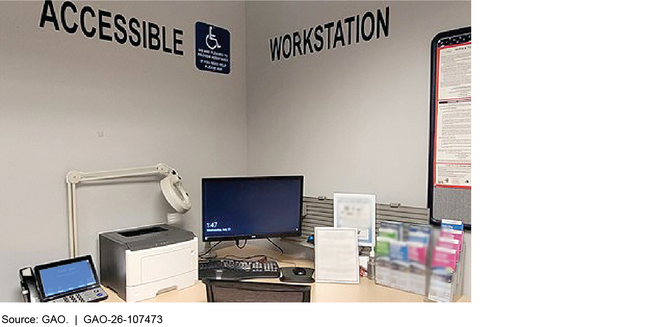
State and local workforce agencies GAO visited have made various efforts to ensure their programs are accessible to participants with disabilities. For example, officials GAO interviewed said they have provided assistive technology such as computers that are accessible to people with visual impairments (see figure). However, officials also reported challenges ensuring that training provided outside of job centers is accessible and providing certain accommodations such as sign language interpreters.
Computer Workstation with Accessibility Features at a Job Center
DOL monitors state and local workforce agencies to help ensure its programs are accessible but does not routinely analyze monitoring results. DOL’s monitoring reports include an examination of state and local accessibility efforts, but the agency has not developed a procedure to analyze them at an aggregate level, which increases the risk the agency will fail to identify and address widespread issues. Also, DOL has provided guidance and technical assistance on a range of accessibility topics. However, officials GAO interviewed in several local areas were not aware of or do not use these resources. Without evaluating awareness or use of its guidance and assistance, DOL may miss opportunities to improve dissemination of materials or take other actions to promote them.
Why GAO Did This Study
The Workforce Innovation and Opportunity Act authorizes programs that help job seekers access services at locations called job centers. It prohibits discrimination, requiring that services be accessible to people with disabilities. GAO was asked to examine efforts to ensure programs are accessible.
This report addresses (1) the share of participants in selected DOL workforce programs that report disabilities and use services, and their employment outcomes, (2) the efforts made and challenges faced by state and local workforce agencies to ensure the programs’ services are accessible to people with disabilities, and (3) DOL’s efforts to ensure the programs are accessible.
GAO analyzed participant-level DOL data from July 1, 2023 through June 30, 2024, the most recent year available; reviewed relevant federal laws, policies, and agency documents; interviewed DOL and state officials, disability organizations, and participants with disabilities; and visited a non-generalizable sample of 12 job centers in Arkansas, Oregon, Virginia, and the District of Columbia, selected for variation in geographic location, urban or rural population, and percentage of participants with disabilities.
Recommendations
GAO is making three recommendations: that DOL (1) take additional steps to collect more complete data on participants’ disability type, (2) develop a procedure to routinely analyze state monitoring reports, and (3) evaluate awareness and use of guidance and technical assistance. DOL disagreed with the first recommendation and agreed with the other two. GAO maintains that additional steps to collect more complete data are needed, as discussed in the report.
Recommendations for Executive Action
| Agency Affected | Recommendation | Status |
|---|---|---|
| Department of Labor | The Secretary of Labor should take additional steps to collect more complete data on workforce program participants' disability types. These steps could include targeting technical assistance to states where these data are less complete. (Recommendation 1) |
DOL disagreed with this recommendation. In July 2026, DOL said it could take additional steps to increase the completeness of data on individual disability type but cannot commit to increasing data completeness, as individuals may exercise their right to either disclose or withhold this sensitive health information. We continue to believe our recommendation is warranted as DOL could take additional steps without requiring disclosure. To address this recommendation, DOL should take additional steps to collect more complete data, such as providing technical assistance to specific states where data are less complete.
|
| Department of Labor | The Secretary of Labor should develop a written procedure for routinely analyzing DOL's state monitoring reports, including associated reports on local workforce agencies, to identify any widespread issues with accessibility for people with disabilities and take appropriate action to address them. (Recommendation 2) |
DOL agreed with this recommendation. The agency stated that it will develop additional procedures on routinely analyzing monitoring reports in its next update to an employment and training order on grants management policies and responsibilities. In July 2026, DOL said the update will be completed by the end of fiscal year 2027. To address this recommendation, DOL should complete these additional procedures.
|
| Department of Labor | The Secretary of Labor should evaluate state and local workforce agencies' awareness and use of guidance, including its promising practices guide at such time as it is reposted to its website, and technical assistance on ensuring accessibility of its workforce programs for people with disabilities and take steps as needed to improve dissemination or promotion. (Recommendation 3) |
DOL agreed with this recommendation. The agency stated that it will identify methods and opportunities to increase dissemination of resources and technical assistance and assess state and local workforce agencies' awareness of them. In July 2026, DOL said it will use platforms, such as WorkforceGPS and will increase dissemination of both new and existing resources and materials. To address this recommendation, DOL will need to evaluate state and local workforce agencies' awareness and use of guidance and technical assistance, including its promising practices guide at such time as it is reposted to its website.
|