
Russia Sanctions and Export Controls: U.S. Agencies Should Establish Targets to Better Assess Effectiveness
Fast Facts
The U.S. and its allies have frozen billions in Russian assets and controlled exports of important technologies to Russia in response to the war in Ukraine. However, Russia has taken actions to mitigate the impact of these restrictions. We found that Russia’s economy declined after the invasion and sanctions in 2022, but recovered somewhat afterward. Moreover, export restrictions have hindered but not completely prevented Russia from obtaining technologies critical to its war effort. We recommended that U.S. agencies set targets to help measure the effectiveness of their sanctions and export controls on Russia.
Tanker used to evade sanctions on Russian oil

Highlights
What GAO Found
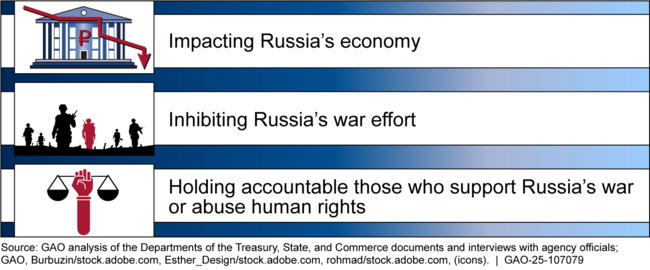
GAO independently identified three broad categories for the objectives of U.S. sanctions and export controls on Russia (see figure). U.S. agencies have made progress toward these objectives, but Russia has circumvented some U.S. sanctions and export controls. Specifically, GAO found that Russia's economic growth was about 6 percentage points lower in 2022 than what might have happened absent the events in 2022, including the invasion of Ukraine and sanctions. However, GAO's analysis did not find that economic growth was statistically different than expected in 2023 and 2024. A price cap on Russian oil likely kept Russian oil production and exports relatively stable but Russian actions, such as the use of a “shadow fleet” to export oil, limited the cap's efficacy. U.S. agencies assess that export controls have hindered but not completely prevented Russia's efforts to obtain U.S. military technologies. While U.S. agencies have taken various actions to hold malign Russian actors accountable, including freezing assets, the agencies reported challenges in assessing their effectiveness.
GAO-Identified Categories for the Objectives of U.S. Sanctions and Export Controls on Russia
U.S. agencies primarily responsible for implementing sanctions and export controls on Russia have not established clearly defined objectives linked to measurable outcomes with targets for their activities. As a result, agencies cannot fully assess progress towards achieving their objectives, thus limiting the U.S. government's ability to determine the effectiveness of its broader sanctions and export controls efforts related to Russia. This information is crucial for improving current efforts and informing the future use of sanctions and export controls.
As of September 30, 2024, U.S. agencies had obligated about $164 million in Ukraine supplemental funding for activities related to sanctions and export controls on Russia. These agencies used this funding for staff and investigative tools, among other uses. For example, a Department of State bureau used supplemental funding to increase the size of its workforce dedicated to identifying Russian sanctions targets. GAO found that two State bureaus have not assessed risks to these sanctions activities when their supplemental funding expires on September 30, 2025. As a result, the bureaus cannot develop an effective plan to sustain or restructure these activities, threatening broader goals.
Why GAO Did This Study
The U.S. and its allies responded to Russia's 2022 invasion of Ukraine with wide-ranging sanctions and export controls, including a price cap on Russian oil. U.S. agencies received additional resources under Ukraine supplemental appropriations acts, some of which they used for sanctions and export controls.
Congress included a provision in Public Law 117-328 for GAO to conduct oversight of Ukraine supplemental funding. For U.S. sanctions and export controls related to Russia's invasion of Ukraine, this report examines progress toward objectives and the extent to which U.S. agencies have established objectives with measurable outcomes and assessed risks to activities funded by supplemental resources, among other objectives.
GAO analyzed agency documents and data, performed economic analyses, reviewed relevant literature, interviewed agency officials, and selected and interviewed 11 knowledgeable stakeholders, including former government officials and economists. GAO selected these stakeholders based on their expertise related to sanctions or export controls.
Recommendations
GAO recommends that U.S. agencies define objectives with targets for sanctions and export controls on Russia, assess progress toward these objectives, and that two State offices assess the risks to their programs without future supplemental funding. Commerce and Treasury agreed with our recommendations. State partially agreed.
Recommendations for Executive Action
| Agency Affected | Recommendation | Status |
|---|---|---|
| Department of State | The Secretary of State should define objectives that are linked to measurable outcomes with targets for the department's efforts related to sanctions and export controls on Russia. (Recommendation 1) |
In its comments on our report, State agreed with this recommendation and with the utility of defining objectives that are linked to measurable outcomes with targets for its Russia sanctions and export controls, but disagreed that it had not done so. In March 2026, State reiterated that it has clear and consistent objectives and that tying objectives to measurable indicators may not capture the larger political and strategic goals of sanctions and export controls on Russia. We continue to believe that defining objectives linked to measurable outcomes with targets is critical for guiding State's efforts and enabling a full assessment of the U.S. government's Russia sanctions and export controls efforts. We will continue to monitor State's progress towards implementing this recommendation.
|
| Department of the Treasury | The Secretary of the Treasury should define objectives that are linked to measurable outcomes with targets for the department's efforts related to sanctions on Russia. (Recommendation 2) |
In its comments on the report, Treasury agreed in principle with this recommendation. Treasury noted it highly values sanctions development that is outcome based and rooted in analytical rigor and assessment, although such analysis can be challenging due to data limitations and other factors. It highlighted various actions it has taken to establish a foundation for greater analytical rigor, such as the creation of a Sanctions Economic Analysis Division in April 2023. Treasury stated that it will continue to develop expertise and advance its capabilities to measure the efficacy of agency actions, commensurate with available resources. As of March 2026, Treasury had not provided any additional information on its progress in implementing this recommendation. We will continue to follow up with Treasury to obtain updates.
|
| Department of Commerce | The Secretary of Commerce should define objectives that are linked to measurable outcomes with targets for the department's efforts related to export controls on Russia. (Recommendation 3) |
We provided a draft of this report to Commerce for review and comment. In response, Commerce stated that it concurred with this recommendation. In particular, Commerce noted that it believes establishing measurable outcomes can make export controls more effective, described various ways it has attempted to do so in the context of export controls for Russia, and pledged to continue to do so in the future. In March 2026, Commerce told us that the department does not plan to provide additional updates on its progress in addressing this recommendation. We believe this recommendation is still valid and will continue to follow up with Commerce as necessary.
|
| Department of State | The Secretary of State should assess the department's progress toward achieving the measurable outcomes it establishes for its efforts related to sanctions and export controls on Russia. (Recommendation 4) |
In its comments on our report, State agreed with this recommendation and noted that there should be an assessment of its progress towards achieving measurable outcomes of its sanctions and export controls on Russia, but disagreed that it had not made attempts to measure the impact of such efforts. In March 2026, State said that it continues to monitor and assess various indicators of the impact of U.S. sanctions on Russia. In addition, State noted that the Bureau of Arms Control and Nonproliferation has completed an evaluation of foreign assistance funding related to the implementation of Russia sanctions projects. However, without establishing measurable outcomes with targets, State cannot assess its progress towards their achievement. We will continue to monitor State's progress towards implementing this recommendation.
|
| Department of the Treasury | The Secretary of the Treasury should assess the department's progress toward achieving the measurable outcomes it establishes for its efforts related to sanctions on Russia. (Recommendation 5) |
In its comments on the report, Treasury agreed in principle with this recommendation. Treasury noted it highly values sanctions development that is outcome based and rooted in analytical rigor and assessment, although such analysis can be challenging due to data limitations and other factors. It highlighted various actions it has taken to establish a foundation for greater analytical rigor, such as the creation of a Sanctions Economic Analysis Division in April 2023. Treasury stated that it will continue to develop expertise and advance its capabilities to measure the efficacy of agency actions, commensurate with available resources. As of March 2026, Treasury had not provided any additional information on its progress in implementing this recommendation. We will continue to follow up with Treasury to obtain updates.
|
| Department of Commerce | The Secretary of Commerce should assess the department's progress toward achieving the measurable outcomes it establishes for its efforts related to export controls on Russia. (Recommendation 6) |
We provided a draft of this report to Commerce for review and comment. In response, Commerce stated that it concurred with this recommendation. In particular, Commerce noted that it believes establishing measurable outcomes can make export controls more effective, described various ways it has attempted to do so in the context of export controls for Russia, and pledged to continue to do so in the future. As we acknowledge in the report, Commerce also noted that it has monitored progress by analyzing various data sets. In March 2026, Commerce told us that the department does not plan to provide additional updates on its progress in addressing this recommendation. We believe this recommendation is still valid and will continue to follow up with Commerce as necessary.
|
| Department of State | The Secretary of State should ensure that the Bureau of Economic and Business Affairs and the Bureau of International Security and Nonproliferation assess risks to their Russia sanctions and export controls activities related to the depletion of available supplemental funding and the absence of future funding. (Recommendation 7) |
In its comments on our report, State agreed with this recommendation. It noted that neither bureau had conducted a formal risk assessment, but disagreed that these bureaus had not assessed risks to their Russia sanctions and export controls activities related to the depletion of available supplemental funding and the absence of future funding. In March 2026, State noted that supplemental funding had enabled one of its bureaus to quickly staff its Russia sanctions work and another bureau had designed future sanctions programming around its base budgets. However, as State acknowledged, neither bureau has conducted a formal assessment of the risks to their Russia sanctions activities in the absence of supplemental funding. We will continue to monitor State's progress towards implementing this recommendation.
|