
Military Readiness: Comprehensive Approach Needed to Address Service Member Fatigue and Manage Related Efforts
Fast Facts
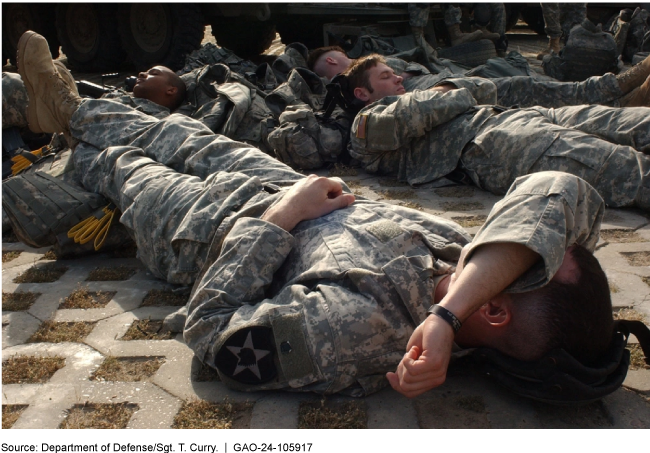
When service members don't get enough sleep, it can affect their performance. Fatigue has led to fatal accidents and hundreds of millions of dollars in damage to ships, vehicles, and aircraft.
For over a decade, Department of Defense surveys have found that the majority of service members report sleeping less than 6 hours a night—despite DOD recommending 7 or more.
DOD has developed guidance on managing fatigue, but it hasn't identified an office or individual to oversee it or assigned leadership to oversee service-level efforts. Doing so will make its efforts more accountable DOD-wide. Our recommendations address this and other issues.
Highlights
What GAO Found
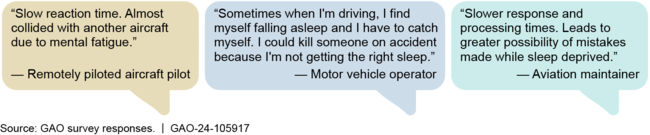
Many service members are not getting the Department of Defense (DOD) recommended 7 or more hours of sleep each day. The department's overarching fatigue-related guidance emphasizes service members obtain at least 7 hours of sleep for optimal performance and readiness. For over a decade, DOD surveys have found that the majority of service members report sleeping 6 or fewer hours per night. Respondents to GAO's nongeneralizable survey cited similar issues. For example, many respondents are sleeping too little, and roughly half of respondents have poor sleep quality regardless of quantity. Survey respondents provided examples of how sleep deprivation has affected their work, from nearly colliding with another aircraft to falling asleep on the job.
Service Members on How Sleep Deprivation Has Affected Their Work
DOD and the services have taken steps to address fatigue-related issues, such as developing guidance on fatigue management, but DOD faces oversight and enterprise-wide collaboration challenges in managing fatigue.
- Oversight structure limitations. DOD has not identified and delegated sufficient oversight authority at the department level, and the military services have not assigned leadership to oversee service-level efforts. Without an assessment of DOD's oversight structure and assigning DOD and service-level leadership, DOD will be hindered in its efforts to limit and manage fatigue across the department.
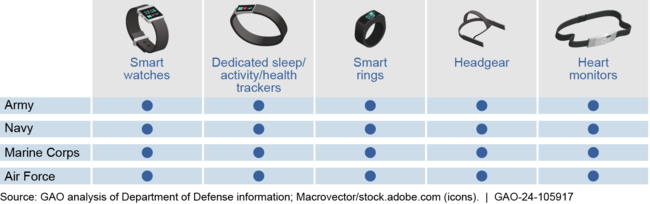
- Fragmented fatigue-related research. GAO identified nearly 130 fatigue-related research projects the Army, Navy, Marine Corps, and Air Force conducted from 2017 to 2023. Forty-eight of these projects studied the use of wearable devices to track sleep data among other uses, with many of them using the same type of technology or even the same model. Establishing a list of all fatigue-related research will help DOD gain visibility and reduce any fragmentation that may exist, potentially leading to cost savings.
Wearable Device Use Across Services for Fatigue-Related Research, 2017—2023
Why GAO Did This Study
Fatigue caused by inadequate sleep can negatively affect a service member's performance and has contributed to accidents resulting in deaths and hundreds of millions of dollars in damage to ships, vehicles, and aircraft. DOD recognizes that impairment from fatigue can be equivalent to the effects of alcohol intoxication and significantly increases the risk of physical injury.
House Report 117-118, which accompanied a bill for the National Defense Authorization Act for Fiscal Year 2022, includes a provision for GAO to review DOD's efforts to limit sleep deprivation and manage fatigue across the military services. Among other things, this report assesses the extent to which (1) service members are getting adequate sleep and (2) DOD has addressed and managed service member fatigue.
GAO analyzed fatigue-related policies and guidance; interviewed cognizant officials; and surveyed service members from selected occupations, including pilots, aviation maintenance personnel, missileers, and motor vehicle operators.
Recommendations
GAO is making nine recommendations, including that DOD conducts an assessment of its fatigue-related oversight structure, assigns DOD leadership, and creates and maintains a list of all fatigue-related research projects, and that the military services assign fatigue-related leadership. DOD generally concurred with the recommendations.
Recommendations for Executive Action
| Agency Affected Sort descending | Recommendation | Status |
|---|---|---|
| Department of Defense |
Priority Rec.
The Secretary of Defense should ensure the Under Secretary of Defense for Personnel and Readiness conducts an assessment of DOD's oversight structure for fatigue-related efforts. This assessment should identify and delegate authority to an office with sufficient authority, sufficient staffing and resources, and committed leadership to act as a focal point for and oversee all DOD-wide fatigue-related efforts. (Recommendation 1) |
The Department of Defense concurred with this recommendation. The Office of the Under Secretary of Defense for Personnel and Readiness formally established the DOD Fatigue-Related Management Working Group in December 2024 to conduct an assessment of DOD's oversight structure for fatigue-related efforts. The working group has established a recurring monthly meeting schedule. Further, the Office of the Under Secretary of Defense for Personnel and Readiness reported that, no later than February 2026, it will formally designate in writing the organization to serve as a focal point for and oversee DOD-wide fatigue-related efforts. As of January 2026, we continue to monitor the department's efforts to identify this focal point.
|
| Department of Defense | The Secretary of Defense should ensure the office identified above to oversee DOD-wide fatigue-related efforts creates and maintains a comprehensive list of all fatigue-related research projects. (Recommendation 6) |
The Department of Defense concurred with this recommendation. As of February 2025, the Office of the Under Secretary of Defense for Personnel and Readiness reported that, no later than May 2026, it will create and publish the comprehensive list of all fatigue-related research projects. The organization will also conduct periodic reviews update the published list as necessary. As of January 2026, we continue to monitor the department's efforts to implement this recommendation.
|
| Department of Defense | The Secretary of Defense should ensure the office identified above to oversee DOD-wide fatigue-related efforts establishes a cross-domain working group dedicated to sharing and communicating fatigue research and related information department-wide. (Recommendation 8) |
The Department of Defense concurred with this recommendation. In December 2025, according to documentation we reviewed, DOD reported that the DoD Fatigue-Related Management Working Group is utilizing the Pix portal for information and research sharing since September 2025. Pix is a U.S. Government-sponsored program designed for unclassified information sharing and collaboration. All Fatigue-Related Management Working Group members are to use this program to share and save all group-related documents. This meets the intent of the recommendation.
|
| Department of Defense | The Secretary of Defense should ensure the Under Secretary of Defense for Personnel and Readiness (1) establishes well-defined time frames for conducting follow-on actions, coordinating with all stakeholders, and identifying key officials responsible for implementing the recommendations of the 2021 DOD study on sleep deprivation and readiness; or (2) documents the reasons that implementing the study's recommendations is not appropriate. (Recommendation 9) |
The Department of Defense concurred with this recommendation. In November 2025, the DOD Fatigue-Related Management Working Group completed a comprehensive information paper detailing DOD's actions to complete and implement the recommendations from the 2021 DOD study on sleep deprivation and readiness. This paper was formally presented to the Joint Safety Council in December 2025.
|
| Department of Defense | The Secretary of Defense should ensure the office identified above to oversee DOD-wide fatigue-related efforts uses the comprehensive list of all fatigue-related research projects to compare fatigue-related research to reduce fragmentation among the initiatives. (Recommendation 7) |
The Department of Defense concurred with this recommendation. As of February 2025, the Office of the Under Secretary of Defense for Personnel and Readiness reported that it is taking steps to create and publish, no later than January 2027, a comprehensive list of all fatigue-related research projects. Once this comprehensive list is created and published, the Office of the Under Secretary of Defense for Personnel and Readiness will use the published list to compare and conduct critical analysis of fatigue-related research to reduce fragmentation among the initiatives. As of January 2026, we continue to monitor the department's efforts to implement this recommendation.
|
| Department of the Air Force | The Secretary of the Air Force should assign leadership responsible for DOD component head responsibilities related to fatigue listed in DOD Instruction 1010.10. (Recommendation 2) |
The Department of the Air Force concurred with this recommendation. In December 2025, the Department of Defense (DoD) Fatigue-Related Management Working Group reported that it had tasked each of the services to identify and designate an office or entity that will head responsibilities related to sleep/fatigue management. The Air Force designated the Air Force Medical Service, Aerospace Medicine Policy & Operations and specific points of contact and provided related documentation.
|
| Department of the Army | The Secretary of the Army should assign leadership responsible for DOD component head responsibilities related to fatigue listed in DOD Instruction 1010.10. (Recommendation 3) |
The Department of the Army concurred with this recommendation. In December 2025, the Department of Defense (DoD) Fatigue-Related Management Working Group reported that it had tasked each of the services to identify and designate an office or entity that will head responsibilities related to sleep/fatigue management. The Army designated the Army Directorate of Prevention, Resilience and Readiness, Ready & Resilient Integration & Training Division and specific points of contact and provided related documentation.
|
| Department of the Navy | The Secretary of the Navy should assign Navy leadership responsible for DOD component head responsibilities related to fatigue listed in DOD Instruction 1010.10. (Recommendation 4) |
The Department of the Navy concurred with this recommendation. In December 2025, the Department of Defense (DoD) Fatigue-Related Management Working Group reported that it had tasked each of the services to identify and designate an office or entity that will head responsibilities related to sleep/fatigue management. The Navy designated the Office of Warfighting Advantage and specific points of contact and provided related documentation.
|
| Department of the Navy | The Secretary of the Navy should assign Marine Corps leadership responsible for DOD component head responsibilities related to fatigue listed in DOD Instruction 1010.10. (Recommendation 5) |
The Department of the Navy concurred with this recommendation. In December 2025, the Department of Defense (DoD) Fatigue-Related Management Working Group reported that it had tasked each of the services to identify and designate an office or entity that will head responsibilities related to sleep/fatigue management. The Marine Corps designated the Semper Fit/Warrior Athlete Readiness and Resilience Branch and specific points of contact and provided related documentation.
|