
Alaska Native Issues: Federal Agencies Could Enhance Support for Native Village Efforts to Address Environmental Threats
Fast Facts
Erosion, flooding, and thawing permafrost can threaten lives and damage infrastructure in Alaska Native villages. Climate change is expected to exacerbate these threats.
Federal agencies budgeted about $200 million in FYs 2016-2020 to build resilience to environmental threats in these villages, but much more needs to be done to protect them. Of the more than 30 federal programs that could help, most are hard for Native villages to access. For example, programs that require participants to share costs with the government can be out of reach for small villages.
Our recommendations address program access and other issues we found.
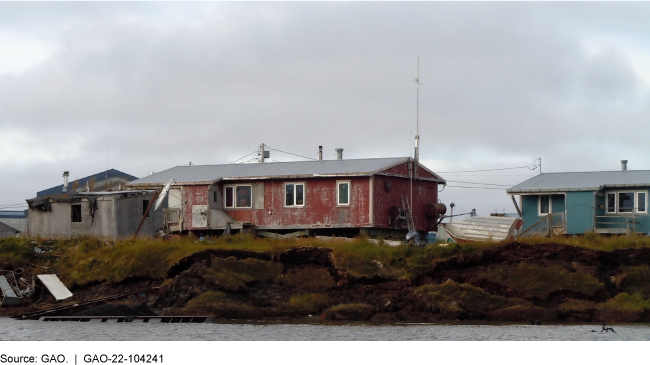
Erosion and thawing permafrost undermine the land beneath homes in Newtok, Alaska
Highlights
What GAO Found
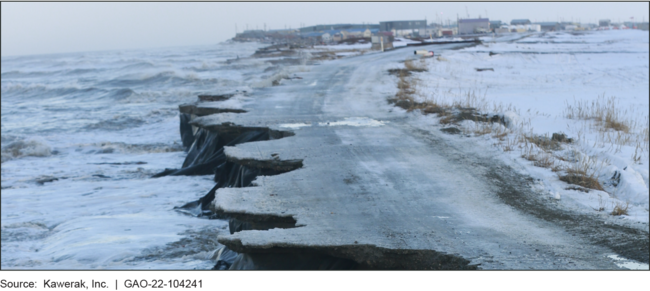
More than 70 out of over 200 Alaska Native villages face significant environmental threats from erosion, flooding, or thawing permafrost, according to a 2019 statewide assessment. Consequences from even a moderate flood or increasing erosion could be significant (see fig.), and over one-third of these communities face the compounding effects of more than one threat. According to several federal officials, short-term actions are needed to address the most urgent threats without waiting for additional studies. At the same time, many Native villages also need more information to support longer-term planning.
Erosion-Damaged Road in the Native Village of Shishmaref
Federal agencies provided a total of about $391 million in obligations in fiscal years 2016 through 2020 to (1) repair damaged infrastructure in Alaska Native villages; and (2) build their resilience to environmental threats, including by implementing protection measures. However, since more than one-third of highly threatened Native villages did not receive such federal assistance during these 5 years, significant work remains to protect these communities.
Opportunities exist for federal agencies to better support Alaska Native village efforts to build resilience to environmental threats by improving coordination among federal, state, and tribal entities. Federal agencies coordinate in several targeted ways, including on a per-project basis, but do not systematically coordinate to address these threats statewide. Broader coordination efforts have been limited because of agencies' focus on their own projects and the absence of consistent federal support for interagency coordination. Establishing an interagency and intergovernmental coordinating entity could facilitate more strategically targeted federal investments that more effectively address the threats facing Alaska Native villages.
Further, GAO reviewed 20 programs across federal agencies and found they each had at least one characteristic that could pose an obstacle to villages' obtaining assistance, such as project cost-share requirements. Implementing changes to address those obstacles that are established in agency regulations or policy, where feasible and appropriate, could help Native villages better obtain federal assistance.
Why GAO Did This Study
Erosion, flooding, and thawing permafrost can pose environmental threats to lives and infrastructure in Alaska Native villages. According to the United States Global Change Research Program, climate change is expected to exacerbate these threats. GAO identified 10 federal agencies that administer programs that support Alaska Native village efforts to address and build resilience to environmental threats.
GAO was asked to review federal efforts to help Alaska Native villages address environmental threats. This report examines (1) information about environmental threats to Native villages; (2) federal funding provided to address such threats, and actions supported by that funding; and (3) opportunities to better support efforts to build resilience to such threats.
GAO analyzed federal risk information and obligations data from 10 federal agencies for fiscal years 2016 through 2020; reviewed agency documents and other relevant reports; and interviewed agency officials and representatives from selected Alaska Native villages and tribal organizations.
Recommendations
Congress should consider establishing a coordinating entity to assist Native villages facing environmental threats. GAO is also making eight recommendations, including that seven agencies change programs to reduce barriers that hinder Native villages' accessing federal assistance. Six of these agencies agreed with GAO's recommendations, and the seventh agency stated it agreed with the report's findings.
Matter for Congressional Consideration
| Matter | Status | Comments |
|---|---|---|
| Congress should consider establishing an interagency and intergovernmental coordinating entity and requiring the relevant agencies to participate and engage in sustained coordination to strategically target federal investments to Alaska Native villages facing significant environmental threats. Congress should also consider directing the coordinating entity and its participating agencies to identify opportunities to streamline program delivery across federal agencies; assess the statutory program characteristics we identified that pose obstacles to Alaska Native villages' obtaining assistance, and identify any others; and submit a report to Congress with any recommendations for statutory changes to streamline program delivery and to address such obstacles. (Matter for Consideration 1) | As of February 9, 2026, Congress has not acted on this matter. |
Recommendations for Executive Action
| Agency Affected | Recommendation | Status |
|---|---|---|
| Bureau of Indian Affairs | The BIA Director should identify options for providing additional technical assistance that is specifically designed to help Alaska Native villages navigate and obtain assistance from the variety of potentially available federal programs, including by assessing how BIA prioritizes its available resources. (Recommendation 1) |
As of July 2025, BIA had taken actions to provide additional technical assistance to help Alaska Native villages obtain assistance from federal programs. For example, BIA hired 8 additional staff who provide direct technical assistance to Alaska Native villages participating in BIA's Voluntary Community Driven Relocation Program. According to BIA officials, these staff, which include specialists in project management, construction, and engineering, may assist Tribes with the navigation of federal funding opportunities. In addition, BIA has provided training to Tribes that received funding for relocation, managed retreat, or protect-in-place coordinators through the Tribal Climate Resilience Program. According to BIA officials, the training provides coordinators with resources to navigate the patchwork of funding available. For example, in 2025, the training included information on strategic planning, funding sources, and proposal writing. In light of these actions, we have closed this recommendation as implemented.
|
| The Denali Commission | The Denali Commission's Federal Co-chair should identify options for providing additional technical assistance that is specifically designed to help Alaska Native villages navigate and obtain assistance from the variety of potentially available federal programs, including by assessing how the Commission prioritizes its available resources. (Recommendation 2) |
The Denali Commission provided funding in fiscal years 2022 through 2025 for technical assistance to help Alaska Native villages obtain assistance from federal programs. Denali Commission funding for this purpose increased in fiscal year 2024, but it has not shown a consistent upward trend since our report was issued. In addition, Denali Commission has used supplemental funding from the Infrastructure Investment and Jobs Act for some of its technical assistance efforts. Denali Commission officials said that the Commission plans to continue providing support for technical assistance but did not indicate if the amounts will increase over time. Further, officials stated that they believe that options for providing additional technical assistance for Alaska Native villages should include other agencies administering programs in Alaska because the Commission has other needs to address in Alaska beyond providing technical assistance. The Commission primarily provided technical assistance funding to the statewide Alaska Native Tribal Health Consortium's Center for Environmentally Threatened Communities. We will continue to monitor the Commission's actions in response to this recommendation to determine if the assistance provided increases.
|
| Bureau of Indian Affairs | The BIA Director should review BIA's programs identified in this report and, where the agency determines it feasible and appropriate, implement relevant changes to address program characteristics that are not established in statute that pose obstacles to Alaska Native villages' obtaining assistance, including characteristics we identified and others that BIA may identify. BIA should also document its review, any related consultation with tribes, and any changes made to its programs. (Recommendation 3) |
As of July 2024, BIA has reviewed the Tribal Climate Resilience Program (TCRP) and implemented changes to address the obstacles to Alaska Native villages obtaining assistance that we identified. Although TCRP is still a competitive grant program-which we reported as an obstacle in our report-BIA has taken steps to help Alaska Native villages access the program. For fiscal year 2024, BIA streamlined the program's request for proposals, including decreasing the number of funding categories and including a succinct list of proposal requirements for each category. In 2023, BIA provided a grant-writing workshop for the program, which is also available online. In addition, the program includes selection criteria that consider relative risk from environmental threats, which, according to BIA, helps ensure that Alaska Native villages receive a significant share of funding from this national grant program. In fiscal year 2024, BIA has also made funds available through TCRP on a rolling basis that can be used to meet the cost-share requirements of other federal programs. We identified such cost-share requirements as an obstacle to Alaska Native villages accessing several of the other programs included in our report. We have determined that BIA's actions satisfy this recommendation.
|
| Department of Defense | The Assistant Secretary of the Army for Civil Works should direct the Chief of Engineers and the Commanding General of the U.S. Army Corps of Engineers to review the Corps' programs identified in this report and, where the agency determines it feasible and appropriate, implement relevant changes to address program characteristics that are not established in statute that pose obstacles to Alaska Native villages' obtaining assistance, including characteristics we identified and others that the Corps may identify. The Corps should also document its review, any related consultation with tribes, and any changes made to its programs. (Recommendation 4) |
As of December 2025, the Corps has implemented some changes to the seven programs we reviewed but does not intend to take further action to reduce obstacles to Alaska Native villages obtaining assistance. For example, the Corps conducted listening sessions for Tribes, solicited input on limitations or barriers for Tribes to participate in its Tribal Partnership Program, and updated its guidance for that program. Further, two laws made changes to two Corps programs that address some of the obstacles that we had identified. First, the Water Resources Development Act of 2022 establishes a lower cost share requirement for economically disadvantaged communities for a new Alaska-specific program that replaced the Corps' Section 116 Program. Second, the Water Resources Development Act of 2024 makes intertribal consortia and tribal organizations eligible for the Tribal Partnership Program. According to a December 2025 letter from the Assistant Secretary of the Army for Civil Works, the Corps does not plan to take further action on this recommendation, because it is inconsistent with the current administration's policies. We continue to believe this recommendation is valid and will monitor whether the Corps' position changes regarding implementation of the recommendation.
|
| Federal Emergency Management Agency | The Administrator of FEMA should review FEMA's programs identified in this report and, where the agency determines it feasible and appropriate, implement relevant changes to address program characteristics that are not established in statute that pose obstacles to Alaska Native villages' obtaining assistance, including characteristics we identified and others that FEMA may identify. FEMA should also document its review, any related consultation with tribes, and any changes made to its programs. (Recommendation 5) |
As of December 2025, FEMA has taken some actions that could help reduce the obstacles associated with the four programs we reviewed in our report but does not intend to take further action to implement this recommendation. For example, FEMA provided documentation that it has taken some actions that could help Alaska Native villages access competitive grants, including providing set-aside funds, technical assistance, grant writing support, and training. However, FEMA has not documented its review of all four programs and the obstacles identified in our report. In April 2025, FEMA stated that it is no longer taking actions on this recommendation and requested that we close the recommendation as unimplemented. We continue to believe this recommendation is valid and will monitor whether FEMA's position changes regarding implementation of the recommendation.
|
| Department of Housing and Urban Development | The Secretary of Housing and Urban Development should direct the Deputy Assistant Secretary for Native American Programs and the Principal Deputy Assistant Secretary for Community Planning and Development to review HUD's programs identified in this report and, where the agency determines it feasible and appropriate, implement relevant changes to address program characteristics that are not established in statute that pose obstacles to Alaska Native villages' obtaining assistance, including characteristics we identified and others that HUD may identify. HUD should also document its review, any related consultation with tribes, and any changes made to its programs. (Recommendation 6) |
In 2023, HUD began the rulemaking process to update regulations for its Indian Community Development Block Grant Program, which include ICDBG-Imminent Threat grants requirements. HUD issued a Dear Tribal Leader Letter announcing HUD's plans to start the rulemaking process and held 10 formal consultation sessions with Tribes in 2023 and 2024. As of January 2026, the agency was reviewing the ICDBG regulations to remove burdensome regulatory barriers, according to HUD officials. According to these officials, HUD plans to conduct a rulemaking to update ICDBG requirements in the near future and will consider whether to make changes to the regulations for ICDBG-Imminent Threat grants. We will continue to monitor HUD's actions in response to this recommendation and evaluate them when complete.
|
| National Oceanic and Atmospheric Administration | The Administrator of NOAA should review NOAA's programs identified in this report and, where the agency determines it feasible and appropriate, implement relevant changes to address program characteristics that are not established in statute that pose obstacles to Alaska Native villages' obtaining assistance, including characteristics we identified and others that NOAA may identify. NOAA should also document its review, any related consultation with tribes, and any changes made to its programs. (Recommendation 7) |
As of December 2024, NOAA reviewed the National Coastal Resilience Fund (NCRF) and implemented changes to address obstacles to Alaska Native villages obtaining assistance. NOAA concluded that the primary barrier to Alaska Native villages accessing the program is the scope and intent of NCRF. Although NOAA did not make changes to NCRF to address this barrier directly, it provided funding through another program-the Climate Resilience Regional Challenge. Specifically, NOAA provided approximately $75 million in 2024 to support technical assistance for Alaska Native villages. NOAA also updated its guidance for NCRF to clarify that a nonfederal cost share is not required for program applicants. We have determined that NOAA's actions satisfy this recommendation.
|
| Natural Resources Conservation Service | The Chief of NRCS should review NRCS's programs identified in this report and, where the agency determines it feasible and appropriate, implement relevant changes to address program characteristics that are not established in statute that pose obstacles to Alaska Native villages' obtaining assistance, including characteristics we identified and others that NRCS may identify. NRCS should also document its review, any related consultation with tribes, and any changes made to its programs. (Recommendation 8) |
USDA has implemented a change to its Emergency Watershed Protection Program and Watershed Protection and Flood Prevention Program to reduce obstacles to Alaska Native villages obtaining assistance. Specifically, in August 2024, USDA issued a final rule that addressed a barrier NRCS identified by eliminating the requirement for Tribes and tribal organizations to have eminent domain authority to sponsor watershed projects. According to NRCS, this change will better enable Alaska Native villages to receive funding through its watershed programs for infrastructure and recovery projects. In addition, according to agency officials, NRCS staff held an internal discussion about obstacles to Alaska Native villages' obtaining assistance through NRCS Watershed programs and determined that there were no known additional programmatic obstacles. However, as of February 2026, NRCS has not provided documentation of its review of the specific barriers we had identified for these programs that remain in effect, including requiring cost-sharing and cost-benefit analyses, and selecting projects from a national pool of applicants. We will continue to monitor NRCS's remaining actions in response to this recommendation and evaluate them when complete.
|