
Organ Transplantation: HHS Action Needed to Improve Lifesaving Program
Fast Facts
As of May 2025, over 100,000 people in America with severe organ failure were on a waiting list to receive a lifesaving organ transplant. The Department of Health and Human Services oversees the organ transplantation system.
As part of a modernization initiative, HHS has been investigating weaknesses of the system, including how organs are allocated, patient safety oversight, unused organs, and more. But HHS doesn't have specific plans to implement its next phase—which includes taking actions to address the recommendations that came out of those investigations.
Our recommendations address this and more, to help improve this lifesaving program.

A person wearing scrubs rushing a plastic box labeled "human organ" into an operating room setting.
Highlights
What GAO Found
Organ transplantation is the leading treatment for patients with severe organ failure, but as of May 2025, more than 100,000 individuals remained on the national waiting list. The Department of Health and Human Services (HHS) has overseen organ allocation services since 1984, using the same contractor to do so, until recently. In 2024, HHS entered into contracts to assess weaknesses in organ allocation services, as part of a modernization initiative. The assessments target issues, including inequitable organ allocation and insufficient investigation of serious events, such as beginning to recover organs before patient death. However, HHS has not yet developed detailed plans for the next initiative phase, including how it will make reforms to address identified weaknesses. Doing so is crucial to improving HHS’s ability to provide organs to critically ill patients.
Organ Transplants from Deceased Donors, Percent by Type, 2024
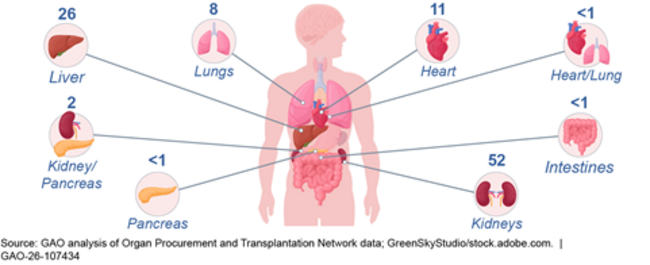
Note: Data show organ transplant types reported by the Organ Procurement and Transplantation Network. In 2024, there were 41,119 organ transplants from deceased donors in the United States.
HHS has not assessed the risks associated with its contractor providing supplementary services outside of its HHS contract, and charging a related monthly fee, to transplant programs. Services include, for example, analytics to help transplant programs manage their waiting lists. In fiscal year 2024, the contractor received about $9.6 million from transplant programs paying the fee. These supplementary services and fee raise several concerns, including whether the services should be provided as part of the contractor’s agreement with HHS and that transplant programs may be paying the fee without realizing it is optional. Assessing the risks associated with this contractor activity, and making changes as appropriate, would better position HHS to ensure it is effectively overseeing its contractor, which has a crucial role in ensuring lifesaving organs are provided to patients effectively and safely.
In 2021, HHS formed a coordination group to improve the organ transplantation system, overseen by two of its agencies. However, the group’s action plan does not include specific, actionable steps with milestone completion dates and measures to gauge success of actions taken. Including these elements, consistent with the group’s charter, would better enable HHS to improve the organ transplantation system through its agencies’ collaborative efforts.
Why GAO Did This Study
Congress and others have raised concerns about systemic issues with organ allocation services, such as the data reliability of the organ matching IT system. In March 2023, HHS announced a modernization initiative to improve organ allocation services.
The Securing the U.S. Organ Procurement and Transplantation Network Act includes a provision for GAO to review the organ transplantation system. This report examines, in part, HHS’s efforts to assess weaknesses in organ allocation services as part of its modernization initiative; the extent to which HHS assesses supplementary services and the fee charged to transplant programs by the contractor; and coordination across HHS.
To conduct this work, GAO reviewed agency and contractor documentation and interviewed officials and representatives from HHS, the contractor, and non-federal groups involved in the organ transplantation system, including providers and patients, among others.
Recommendations
GAO is making three recommendations to HHS, including that it develop detailed plans for the next phase of the modernization inititative; assesses risks associated with its contractor’s supplementary services and fee; and that HHS’s coordination group include in its action plan actionable steps with milestones to gauge success of actions taken. HHS agreed with these recommendations.
Recommendations for Executive Action
| Agency Affected | Recommendation | Status |
|---|---|---|
| Department of Health and Human Services | The Secretary of Health and Human Services should ensure the Administrator of HRSA develops detailed plans for the next phase of its OPTN Modernization Initiative, including how it will make reforms to the OPTN to address its identified weaknesses. The plans should take into consideration GAO's key principles for agency reforms. (Recommendation 1) |
We will update the status of this recommendation when HHS provides its 180-day letter (expected in summer 2026).
|
| Department of Health and Human Services | The Secretary of Health and Human Services should ensure the Administrator of HRSA assesses the risks associated with current and future OPTN contractors' provision of supplementary services and the associated fee and makes changes as appropriate. (Recommendation 2) |
We will update the status of this recommendation when HHS provides its 180-day letter (expected in summer 2026).
|
| Department of Health and Human Services |
Priority Rec.
The Secretary of Health and Human Services should ensure the Administrators of HRSA and CMS take action to ensure that OTAG's (the agencies' organ transplantation system coordination group) action plan includes specific, actionable steps with milestone completion dates and markers for measuring success of actions taken, as directed by the OTAG charter. (Recommendation 3) |
We will update the status of this recommendation when HHS provides its 180-day letter (expected in summer 2026).
|